Asbestos pipe removal in Kent’s pre-2000 cellars, boiler rooms and airing cupboards is the most hazardous asbestos job in common use. Its fibres are loosely bound and release readily when disturbed.
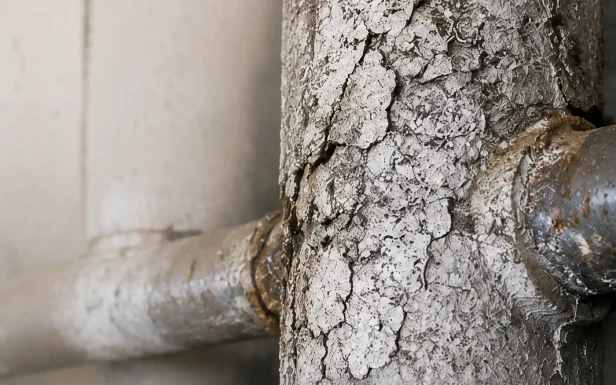

We sample and map the full run, then manage licensed asbestos removal under HSE arrangements: enclosures, negative pressure, decontamination and four-stage clearance, all in one fixed contract.
We handle notification, enclosure, clearance
Encapsulation plan documented as alternative
From the first sample to the clearance certificate, every step follows the licensed regime this material demands. One contract, one fixed price, no shortcuts.

The full extent of the insulation is identified and traced along every run. Lagging conceals itself above ceilings and inside wall voids, and a partial picture produces a partial removal that will need revisiting.

The method statement and enclosure design are confirmed, the required 14-day HSE notification is submitted, and your fixed written price is issued with the full programme timeline built in.

All work takes place inside sealed negative-pressure enclosures with airlocks and decontamination units, operated under the licensed regime that this category of material requires without exception.

An independent analyst carries out visual inspection, a thoroughness check, air testing inside the enclosure and a final assessment once the enclosure is dismantled. The clearance certificate, air results and consignment notes are issued together as one pack.
Anyone quoting asbestos lagging removal cheaply without the full licensed regime is quoting you a contamination incident.
The analyst who certifies your space works independently from the removal contractor. That separation is what makes the certificate meaningful.
We trace and price the complete pipe run so the job does not have to be revisited in twelve months.
Your boiler installer or heating contractor is booked in directly behind the clearance certificate.
FAQS
It typically presents as a thick, firm whitish or grey coating wrapped around older heating pipework, sometimes covered in hessian fabric or painted over. Most commonly found in systems installed before 1975. Appearance alone cannot confirm it either way, so if you suspect it, do not touch or disturb it. Photograph it and have it sampled.
Not at all. A plumber who stops at suspected lagging is doing exactly the right thing. The material must be professionally identified and, if it tests positive, removed under licensed conditions before any heating work can lawfully proceed. We move quickly on sampling so your boiler project is delayed by days rather than weeks.
Because the fibres are loosely bound in the insulation matrix and become airborne at high concentrations during removal. This is the opposite of cement, where fibre is locked tightly and released only under significant disturbance. The controls the law requires are scaled to the risk, and lagging sits at the very top of that scale.
An independent analyst carries out four sequential checks: a visual inspection of the stripped area, a thoroughness assessment, air testing inside the sealed enclosure and a final check once the enclosure itself has been taken down. Only after all four stages are passed is the space certified safe for reoccupation. That is when we consider the job complete.
Where the material is genuinely intact, out of reach and not at risk of disturbance, encapsulation and labelling under a formal management plan is a recognised option. Where it is deteriorating, damaged or in the path of any planned works, removal is the only appropriate response. We will give you an honest written assessment with both options costed where both genuinely apply.
Building the enclosure, carrying out the removal, completing the four-stage clearance and striking the enclosure typically takes several days for a modest run. The 14-day HSE notification establishes the earliest possible start date, and we set out the complete programme calendar in your quotation so heating downtime is something you can plan around.
The area containing the enclosure must be vacated throughout. The evacuation boundary and the point at which reoccupation is permitted, which is the date the clearance certificate is passed, are both stated in your quotation before any work begins.
An independent UKAS-accredited analyst who has no connection to the team that carried out the removal. That independence is not a formality. It is the mechanism that gives the certificate its authority and gives you genuine confidence in the result.
We carry out asbestos removal across Kent, covering cellars and plant rooms in Victorian properties, boiler houses in blocks and schools, and commercial plant rooms across the county. The 14-day notification sets the programme start wherever the job is located, and we map the full calendar in the quotation.
For enquiries related to our services, please reach out.
[email protected]
[email protected]
Speak to a surveyor, not a call handler.
Sales
07798 984290
Support / Enquiries
07468 437558
2 Park Rd
Guildford GU1 4PH
United Kingdom
CONTACT US
Send us your postcode and a description of the material you’ve found. A surveyor will be with you the same week, and your fixed written price follows within 48 hours.