Removal, encapsulation, enclosure and repair are the four asbestos abatement tools. Each has a legitimate role. Carrying all four means the recommendation follows what the material actually needs.

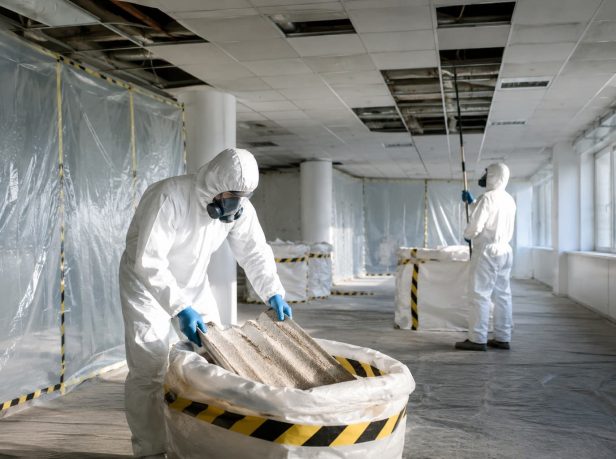
Survey data drives the plan. Each material gets its proportionate control, priced individually. A mixed building gets a mixed, coherent answer and the register is updated when works are done.
Domestic, commercial and industrial all done
Phased across years where budgets require it
From material-by-material assessment to updated register, every step is documented and every recommendation carries its reasoning in writing.

Every item is scored for condition, friability, location and disturbance risk. This evidence base is what the recommendation sits on and what you can scrutinise before committing to anything.
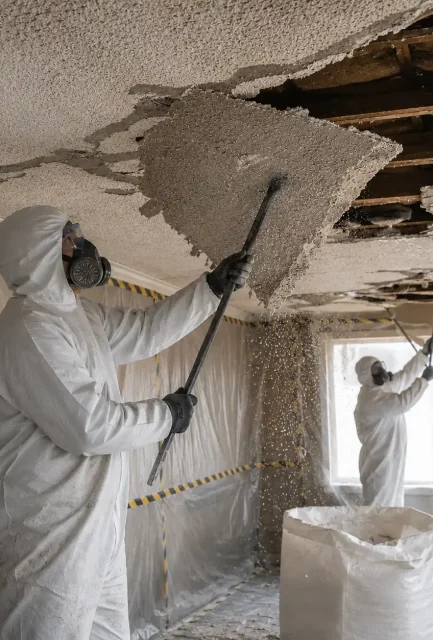
Each material is matched to its proportionate control with costs set out side by side: remove, encapsulate, enclose or repair and monitor. You choose with the full picture in front of you.

Works are carried out under the correct regime for each material, whether non-licensed, NNLW or licensed arrangements, with air testing included where the category requires it.

Completion documentation is issued and the asbestos register updated to show what was done, why, and what remains under active management. The strategy survives the works.
We coordinate every abatement stage in sequence. One team, one contact, and one fixed price throughout.
We handle both non-licensed and HSE-licensed materials with no need to bring in additional contractors.
We carry £10m public and employer liability insurance as standard on every abatement programme we deliver.
We issue survey reports, lab certificates, consignment notes, and clearance certificates on every completed abatement programme.
FAQS
Asbestos abatement removal is one of four control methods. Abatement is the broader discipline of matching each material to the appropriate control, whether that is removal, encapsulation, enclosure or repair, based on the actual risk rather than a default preference. The distinction matters most when a building has significant quantities of managed material and a finite budget to work with.
When the material is in sound condition, well bonded to its substrate and not at risk of being disturbed in normal use. A stable coating in a low-traffic area is a classic candidate. Asbestos encapsulation stabilises it for a fraction of what removal would cost. Where material is deteriorating, damaged or in a location where future works or everyday wear are likely to disturb it, removal is the right answer and earns its cost.
Sometimes managed retention is the correct technical answer. A good deal of managed asbestos will remain entirely stable for decades, well beyond any realistic planning horizon for the building. The version that creates a problem is managed retention without documentation. A properly registered, reinspected managed-in-place approach is a strategy, not an avoidance.
Yes. Priority items are addressed first. Stable items are scheduled across subsequent phases. Each phase is fixed-priced individually and the register is updated as each phase completes. Risk scoring determines the order that is safe and defensible.
Item by item against the chosen control method for each, assembled into a single written programme figure. You can see exactly what each decision costs, including what it would cost to choose the alternative control for any given item. That transparency is what makes the options table genuinely useful.
You do, with our written recommendation and reasoning provided for every item. We will make a clear case where safety considerations make one option clearly preferable, but informed clients choosing between legitimate, proportionate controls is exactly how the process should work.
Any building with more than a small number of managed materials. Schools, residential blocks, commercial portfolios and larger properties mid-renovation are all examples where the programme’s value increases with the number of decisions it brings into one coordinated plan.
For removed items, yes. For items that have been encapsulated, enclosed or repaired, those entries move into the monitoring cycle with reinspection dates attached. The register update at the end of the works is what converts a set of individual jobs into a coherent ongoing strategy.
We carry out asbestos removal across Kent covering every building type and every part of the county, and where a portfolio extends beyond Kent’s borders the programme extends with it. One reporting standard, one register format, however many sites are involved.
For enquiries related to our services, please reach out.
[email protected]
[email protected]
Speak to a surveyor, not a call handler.
Sales
07798 984290
Support / Enquiries
07468 437558
2 Park Rd
Guildford GU1 4PH
United Kingdom
CONTACT US
Send us your postcode and a description of the material you’ve found. A surveyor will be with you the same week, and your fixed written price follows within 48 hours.